Home » News » Regenerative Gas-Fired Aluminum Melting Furnace
Regenerative Gas-Fired Aluminum Melting Furnace
2026-01-08
I. Introduction
1.1 Overview of Regenerative Gas-Fired Aluminum Melting Furnace
1.1.1 Basics of Aluminum Melting Furnaces
Aluminum melting furnaces are core pre-processing equipment in the aluminum production chain. Their primary function is to heat solid aluminum raw materials—such as ingots, scrap aluminum, and aluminum alloy billets—into a molten state, providing aluminum alloy liquid that meets both composition and temperature requirements for subsequent casting, rolling, or die-casting processes. As a key energy-consuming step in aluminum production, the furnace's technological level directly impacts production efficiency, energy costs, and product quality.
1.1.2 Core Positioning of Regenerative Gas-Fired Furnaces
The regenerative gas-fired aluminum melting furnace represents an upgraded iteration of traditional melting furnaces, featuring “heat recovery + efficient combustion” as its core technological advantage. Combining energy efficiency and environmental performance, this next-generation solution captures and reuses waste heat from combustion, significantly reducing fuel consumption and emissions, fully aligning with the global trend toward green manufacturing.
1.1.3 Core Application Scenarios
This furnace is designed for melting recycled aluminum scrap and various aluminum alloys, precisely converting scrap materials—such as discarded aluminum products, machining residues, and aluminum profile scrap—into molten aluminum alloy that meets industrial composition and temperature standards. It is widely applicable in recycled aluminum processing and aluminum alloy production, supplying high-quality molten aluminum to diverse downstream industries.
1.2 Importance in the Aluminum Industry
1.2.1 Supporting Aluminum Recycling and High-Quality Alloy Production
Amid the global trend of aluminum resource recycling, regenerative gas-fired furnaces are essential equipment for recycled aluminum processing. They efficiently handle various aluminum scrap types, minimizing material waste. Meanwhile, precise temperature and composition control ensures stable production of high-purity aluminum and specialty alloys, meeting high-end industrial demands.
1.2.2 Enhancing Production Efficiency and Energy Savings
Energy consumption in aluminum melting accounts for over 30% of total aluminum processing. By leveraging innovative regenerative technology, these furnaces achieve higher thermal efficiency, significantly reducing energy costs while accelerating melting speed. This shortens production cycles and boosts overall plant productivity, providing enterprises with a competitive advantage.
II. Working Principle
2.1 Core Furnace Operation Process
Material Loading: Solid raw materials, such as recycled aluminum scrap or aluminum alloy billets, are loaded into the furnace chamber via a feeding system.
Fuel Combustion: Based on available energy sources, fuels like natural gas, LPG, heavy oil, or diesel are combusted through burners, generating high-temperature heat to melt the aluminum.
Melting and Refining: Under high temperatures, solid aluminum gradually melts. Refining devices remove impurities, such as oxide slag and non-metallic inclusions.
Composition and Temperature Adjustment: Molten aluminum alloys are precisely adjusted to meet downstream production requirements, and the temperature is stabilized within the set range, ensuring the output meets process standards.
2.2 Core Regenerative Gas Technology: Waste Heat Recovery Principle
Heat Storage Phase: Each furnace is equipped with paired regenerative heat exchangers, typically high-strength ceramic honeycomb structures. While one burner operates normally, the other absorbs high-temperature exhaust gases (over 1000°C), rapidly storing heat.
Heat Release Phase: Intelligent valves switch the burners’ operating states. The preheated regenerative body releases stored heat to preheat incoming combustion air, reaching temperatures above 800°C.
Cyclical Advantage: This alternating storage and release process reduces auxiliary heating energy by 30%-40%, enhances furnace combustion efficiency, lowers NOx emissions, and achieves dual benefits of energy saving and environmental protection.
III. Core Features and Advantages
3.1 Diverse Furnace Designs for Various Needs
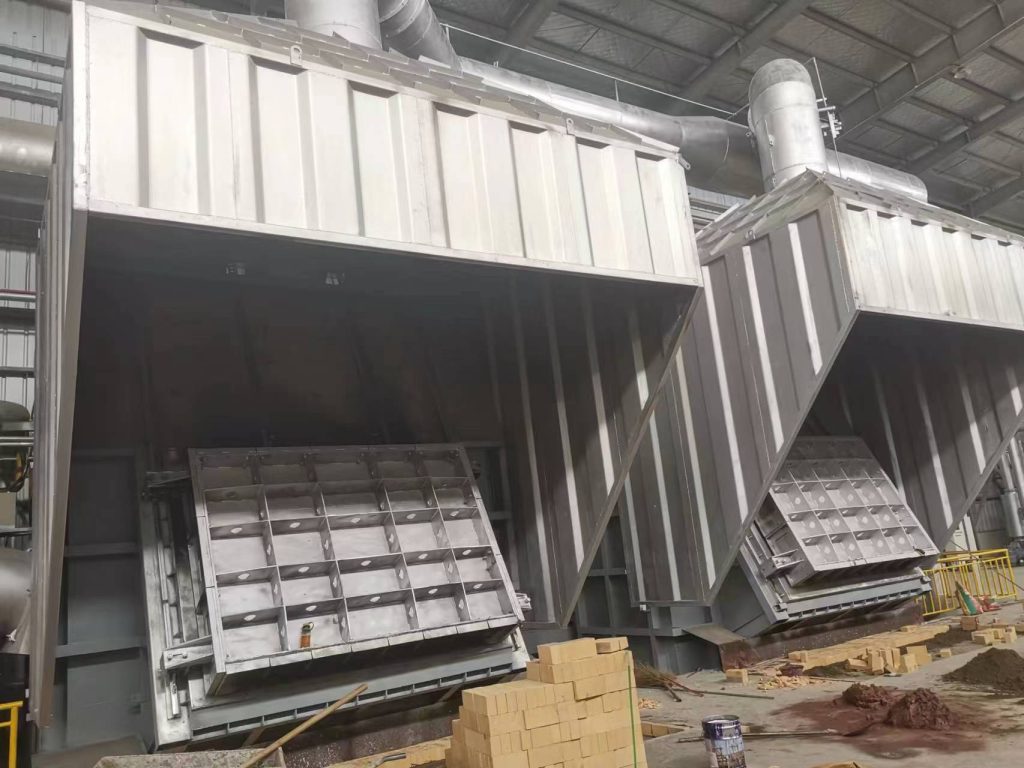
Structural Options: Includes tilt-type, fixed-type, rectangular, and circular furnaces. Tilt-type designs facilitate pouring molten aluminum, ideal for continuous casting or die-casting lines; fixed-type furnaces suit batch processing.
Flexible Adaptation: From small workshops to large-scale production lines, furnaces can be customized to match production requirements, improving workflow compatibility.
3.2 Wide Capacity Range for Small and Large-Scale Production
3.2.1 Key Capacity Parameters
Load Capacity: Ranges from 2 tons to 100 tons per furnace, covering small-scale to large-scale operations.
Melting Speed: 3–12 tons per hour, ensuring efficient production without delays for downstream processes.
3.2.2 Scenario Suitability
Small Furnaces: Ideal for small and medium recycled aluminum businesses or small-batch specialty alloys.
Large Furnaces: Suitable for automotive components, construction profiles, and other large-scale aluminum processing enterprises, enabling high-efficiency mass production.
3.3 Robust Construction for Safety and Longevity
High-Strength Furnace Body: ≥8 mm thick steel plates welded on a sturdy frame, providing excellent load capacity and deformation resistance in high-temperature environments.
Sealing and Insulation: Furnace doors with spring compression and soft-edge dual seals minimize heat loss. High-quality refractory lining inside the chamber enhances insulation and extends service life.
Safety Features: Includes over-temperature protection, pressure monitoring, and other safeguards to ensure safe operation.
3.4 Advanced PLC Automatic Control System
Full Automation: Automatic ignition, combustion adjustment, tilt/reverse functions, and other operations enable unmanned running with minimal operator intervention.
Precise Monitoring & Protection: Real-time data collection for furnace temperature, combustion status, and fuel flow ensures accurate control (±5°C). Flame-out protection, gas leak detection, and alarms enhance safety.
Intelligent Management: Supports integration with MES systems for real-time production monitoring, remote supervision, and data analysis.
3.5 Energy Saving and Environmental Benefits
Maximum Efficiency: Heat recovery reduces fuel consumption by 30%-40%, raising thermal efficiency to 75%-85%, lowering operational costs.
Low Emissions: Low-NOx combustion and efficient control keep NOx <50 mg/m³, with CO and SO₂ emissions well below traditional furnaces, meeting CE, EPA, and GB environmental standards worldwide.
IV. Applications
4.1 Industries Served
Core Industries: Automotive, aerospace, construction, aluminum casting/die-casting. Supplies high-quality molten aluminum for automotive parts, aerospace components, building profiles, and household appliances.
Recycled Aluminum Sector: Efficiently processes scrap aluminum and machining waste, promoting resource recycling and reducing raw material costs.
4.2 Aluminum Alloy Types Processed
Full Alloy Range: Pure aluminum, secondary aluminum, and common alloys such as 6061, 6063, 5052, 7075, and 2024.
Precise Composition Adjustment: Professional detection and adjustment systems ensure molten alloy meets industrial standards for downstream applications.
V. Why Choose Our Regenerative Gas-Fired Aluminum Melting Furnace?
5.1 Significant Cost Savings
Energy Reduction: Regenerative technology drastically lowers fuel consumption, saving tens of thousands per year per furnace.
Optimized Operation Costs: Automated control reduces labor, robust construction minimizes failures, and precise melting reduces oxidation losses (≤1.5%).
5.2 Easy Operation and Low Production Threshold
Fully automated PLC control simplifies operation. Touchscreen interfaces provide intuitive parameter settings and status monitoring, lowering operational barriers.
5.3 Safety and Reliability
Robust structure and comprehensive safety systems (flame-out protection, over-temperature alarms, gas leak detection) ensure continuous, safe operation with minimal downtime.
5.4 Flexible and Scalable
Available from 2 to 100 tons with customizable structures (tilt/fixed). Modular design supports future expansion, meeting phased production growth.
VI. Conclusion
Our regenerative gas-fired aluminum melting furnace combines high efficiency, energy savings, low emissions, flexible adaptation, and intelligent automation. It offers global aluminum enterprises a full-process solution—from recycled aluminum processing to high-quality alloy production—reducing costs, improving productivity, and meeting international environmental standards.
Whether for small recycling centers or large aluminum manufacturers, we provide customized equipment solutions and professional technical support. Contact us today for tailored consultation and precise quotations, and join us in driving green, efficient development in the aluminum industry.
In industrial heat treatment, achieving stable metallurgical properties while controlling energy consumption and operating costs is a long-standing technical challenge.…
I. Introduction 1.1 Industrial Positioning of Aluminum Ingot Production Lines Within the non-ferrous metal processing industry system, aluminum ingot production…