In industrial heat treatment, achieving stable metallurgical properties while controlling energy consumption and operating costs is a long-standing technical challenge. Annealing and tempering processes demand not only precise temperature control, but also uniform heat distribution, structural reliability, and operational safety.
The Car-Bottom Annealing Furnace, commonly known as a trolley furnace, is a cycle-operated electric furnace specifically designed to meet these requirements. Due to its robust mechanical structure, efficient insulation system, and flexible loading capacity, it has become a widely adopted solution for medium and large-sized workpieces in modern manufacturing.
From an engineering perspective, this furnace represents a balanced combination of thermal efficiency, process stability, and operational practicality.
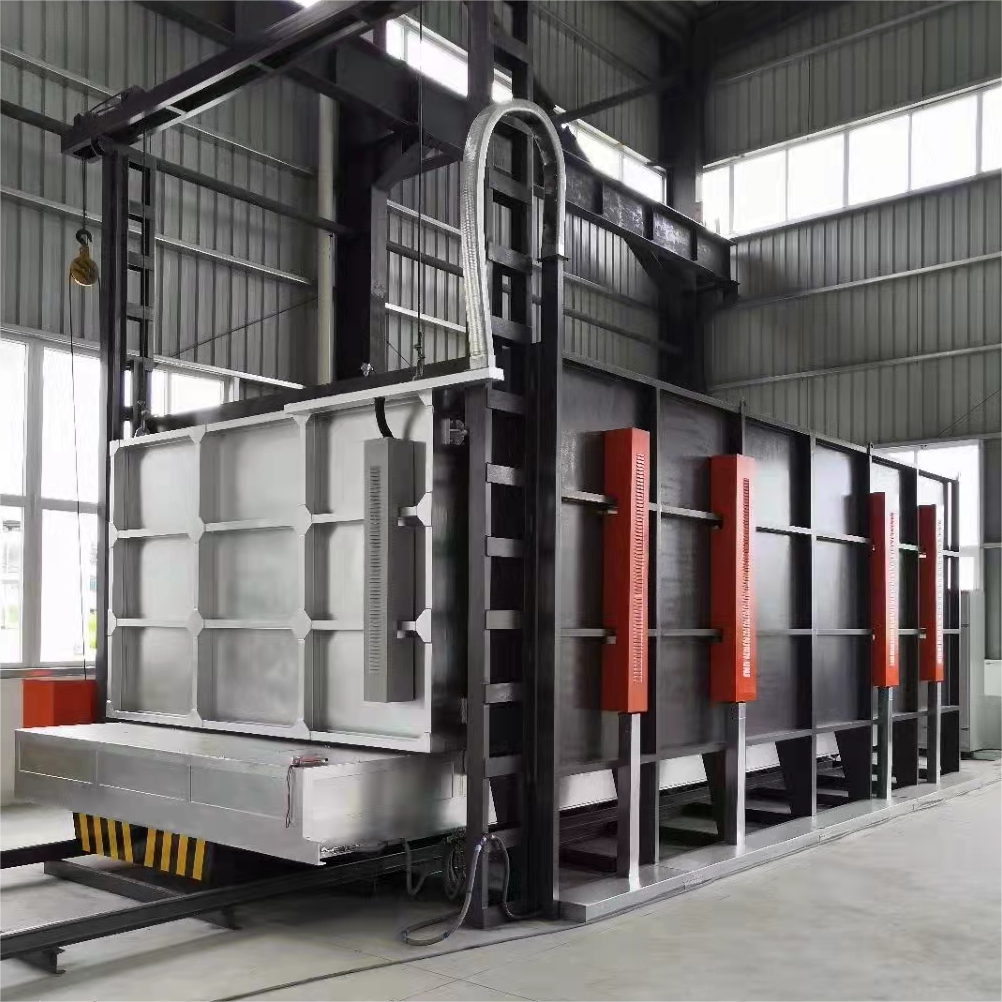
A Car-Bottom Annealing Furnace is a box-type electric resistance furnace equipped with a movable car-bottom (trolley). Workpieces are loaded onto the trolley outside the furnace chamber and then transferred into the heating zone, minimizing manual handling and improving operational safety.
This configuration is particularly suitable for heavy, bulky, or irregular-shaped components that are difficult to load into conventional fixed-bottom furnaces.
One of the most critical factors affecting furnace performance is heat insulation. The Car-Bottom Annealing Furnace uses ultra-light refractory fiber lining instead of traditional dense refractory bricks.
| Parameter | Fiber Lining | Traditional Refractory Brick |
|---|---|---|
| Thermal Conductivity | Low | High |
| Heat Storage | Minimal | Significant |
| Heating Response | Fast | Slow |
| Energy Consumption | Reduced | Higher |
| Furnace Weight | Lightweight | Heavy |
This design significantly reduces heat loss and thermal inertia, allowing faster heating cycles and lower electricity consumption. More importantly, it helps maintain uniform temperature distribution, which is essential for consistent annealing and tempering results.
The trolley is not merely a transport platform; it is an integral part of the thermal system.
It is constructed using a combination of insulating bricks and refractory bricks, ensuring that the heat inside the furnace is retained even when handling large thermal loads.
This design ensures that material temperature consistency is preserved throughout the heat treatment cycle, reducing the risk of uneven microstructures or mechanical property variations.
The furnace is equipped with U-shaped high-resistance alloy heating elements, strategically installed on:
| Feature | Description |
|---|---|
| Heating Element Type | High-resistance alloy strip |
| Element Shape | U-shaped |
| Distribution | Multi-zone layout |
| Heating Speed | Fast and stable |
| Maintenance Requirement | Low |
| Service Life | Long |
This configuration allows for precise temperature control and uniform heat flux, minimizing thermal stress on workpieces and improving metallurgical stability.
The furnace door uses a gravity-based self-sealing design, relying on its own weight to achieve tight closure.
This seemingly simple design plays a crucial role in overall energy efficiency and process reliability.
Unlike many traditional industrial furnaces, the Car-Bottom Annealing Furnace does not require a dedicated foundation.
This makes it particularly attractive for manufacturers who need flexible production layouts or capacity expansion.
| Parameter | Typical Range |
|---|---|
| Furnace Type | Electric resistance, cycle-operated |
| Operating Temperature | 300 – 1200°C |
| Heating Method | Resistance heating |
| Furnace Lining | Refractory fiber |
| Loading Method | Trolley (car-bottom) |
| Temperature Uniformity | ±5–10°C |
| Control System | PID automatic control |
| Installation Requirement | No foundation |
Parameters can be customized based on material type, load weight, and production requirements.
The Car-Bottom Annealing Furnace is widely used in:
Its adaptability allows manufacturers to process a wide range of materials without compromising quality.
From a production and cost-control perspective, this furnace offers measurable benefits:
These advantages contribute directly to higher yield rates, better product performance, and long-term operational savings.
From an engineering standpoint, the Car-Bottom Annealing Furnace is not simply a heat treatment device, but a well-integrated thermal system designed for reliability, efficiency, and flexibility. Its optimized insulation, precise heating control, and practical mechanical design make it a proven solution for modern industrial heat treatment.
For manufacturers seeking consistent metallurgical quality, lower energy costs, and adaptable production capacity, the Car-Bottom Annealing Furnace remains a technically sound and economically efficient choice.
The furnace is lined with ultra-light, energy-saving refractory fiber, which significantly reduces heat loss.
This advanced insulation helps manufacturers achieve consistent annealing and tempering results, critical for maintaining material performance and meeting high-quality standards.
The furnace trolley is constructed with insulating bricks and refractory bricks, providing excellent thermal insulation.
Whether you are treating forgings, steel rolls, or precision mechanical parts, the insulated trolley ensures high-quality results every time.
The Car-Bottom Furnace features U-shaped, high-resistance alloy strips, strategically installed on both sides of the furnace, the furnace door, the rear wall, and the trolley.
With this setup, manufacturers can maintain precise control over annealing and tempering cycles, improving product consistency and overall quality.
The furnace door is automatically sealed using its own weight, a design that:
This feature makes the furnace easy to operate while ensuring optimal energy performance.
Unlike other industrial furnaces, the Car-Bottom Annealing Furnace requires no foundation installation.
This simplicity allows manufacturers to adapt quickly to production needs without compromising efficiency.
The Car-Bottom Annealing Furnace is highly versatile, suitable for a wide range of industries and materials:
Its adaptability makes it a go-to solution for manufacturers looking to improve product quality and consistency.
Investing in a Car-Bottom Annealing Furnace brings clear advantages:
These benefits translate into higher production efficiency, improved material performance, and a strong return on investment for your business.
The Car-Bottom Annealing Furnace is more than a piece of equipment—it’s a strategic asset for modern manufacturing. By combining energy-efficient design, precise temperature control, and flexible operation, it enables manufacturers to achieve high-quality results, reduce costs, and optimize production.
Whether your goal is to improve the mechanical properties of steel, increase wear resistance, or streamline heat treatment processes, this furnace is designed to deliver reliable, consistent, and cost-effective performance.
Contact us today to learn more about specifications, pricing, and how the Car-Bottom Annealing Furnace can transform your production line and maximize efficiency.
I. Introduction 1.1 Overview of Regenerative Gas-Fired Aluminum Melting Furnace 1.1.1 Basics of Aluminum Melting Furnaces Aluminum melting furnaces are…
Introduction In modern industrial processes, precise thermal management is essential for maintaining the performance and longevity of high-power equipment such…
A Technical and ROI-Driven Guide for Industrial Decision-Makers Introduction In stainless steel production, the melting furnace is not merely a…
Why Aluminum Scrap Is Ideal for Melting and Recycling Before selecting an aluminum scrap melting furnace, it is important to…