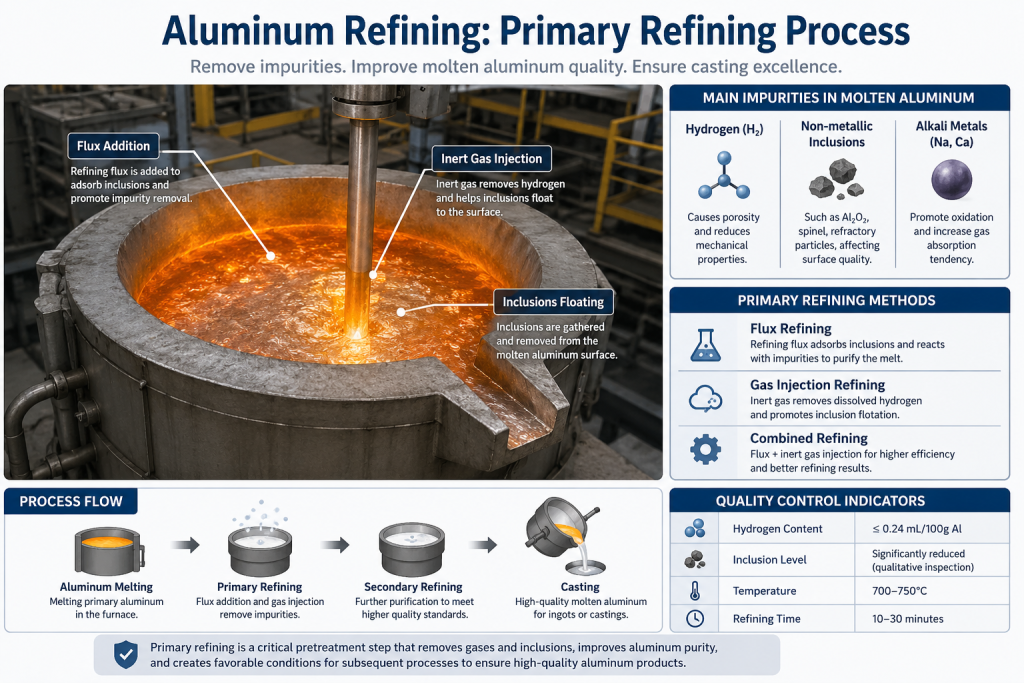
Primary refining of molten aluminum is a technical measure taken in response to the characteristics of primary molten aluminum. This is because primary molten aluminum contains relatively high levels of gases, such as hydrogen, and non-metallic inclusions, such as aluminum oxide.
In other words, the initial purity of primary molten aluminum—used as the main raw material—is relatively low, and the refining measures applied after melting aluminum ingots for remelting alone cannot fully meet product quality requirements.
The purpose of primary refining is to remove some of the oxide inclusions, gases, and metallic sodium from the molten aluminum.
In practice, primary refining serves as a pretreatment for molten primary aluminum. It creates favorable conditions for the refining process prior to casting, thereby ensuring that product quality requirements are met.
To ensure the effectiveness of the final refining process, electrolytic primary aluminum must first undergo pretreatment with a flux—that is, primary refining.
Numerical requirements have been established for the results of primary refining: the gas content after treatment must not exceed 0.24 mL/100.
When producing aluminum ingots for remelting, only the first refining step is required; a second refining step is unnecessary.
From the perspective of enhancing the overall technical level of the aluminum industry, performing the first refining on molten primary aluminum intended for remelting is essential. This improves the purity of the ingots for remelting and creates favorable conditions for subsequent production processes to enhance product quality.
During the primary aluminum smelting process, molten aluminum typically contains three major categories of impurities:
To address the above impurities, several molten aluminum refining techniques are applied:
In a complete aluminum production workflow, primary refining is positioned as a critical pretreatment step:
Aluminum Melting → Primary Refining → Secondary Refining → Casting
To ensure stable refining quality, the following parameters are typically controlled:
| Parameter | Standard Requirement |
|---|---|
| Hydrogen content | ≤ 0.24 mL/100g Al |
| Inclusion level | Significantly reduced (qualitative inspection) |
| Temperature | 700–750°C (typical refining range) |
| Refining time | 10–30 minutes depending on capacity |
These indicators are especially important for industries requiring high-quality aluminum, such as:
From an industrial perspective, primary refining of molten aluminum directly impacts:
Primary refining is not just a preliminary step—it is a foundational process in aluminum metallurgy. By effectively removing gases and inclusions at an early stage, manufacturers can significantly improve the overall quality, consistency, and performance of aluminum products.
For companies aiming to optimize their aluminum melting and refining process, investing in proper primary refining technology is essential to remain competitive in modern industrial production.
Why Aluminum Scrap Is Ideal for Melting and Recycling Before selecting an aluminum scrap melting furnace, it is important to…
Steel deoxidation is one of the most critical steps in the steelmaking process. During melting and refining, oxygen inevitably dissolves…
I. Introduction: The Role of Aluminum Shell Melting Furnaces in Modern Metal Processing 1.1 Growing Demand for Efficient Metal Melting…
1. Industry Background 1.1 Industry Pain Points Driven by strict global environmental regulations and rising energy costs, the aluminum foundry…