In today’s metal casting industry, speed, energy efficiency, and process stability aren’t optional anymore—they’re survival tools. That’s exactly why the MF (Medium Frequency) Induction Melting Furnace has become the core melting equipment in modern foundries.
Let’s walk through how it works, why it outperforms traditional systems, and what industrial buyers should really pay attention to.
Fuel-fired furnaces rely on combustion heating. While simple in structure, they suffer from:
Energy waste and unstable alloy composition make them unsuitable for modern precision casting.
Power-frequency (50/60Hz) induction furnaces improved cleanliness but still face:
Medium frequency systems (typically 200Hz–2500Hz) dramatically increased electrical efficiency, reduced melting cycles, and improved metal quality. Today, they are the standard solution for steel foundries, iron casting plants, and non-ferrous metal processors.
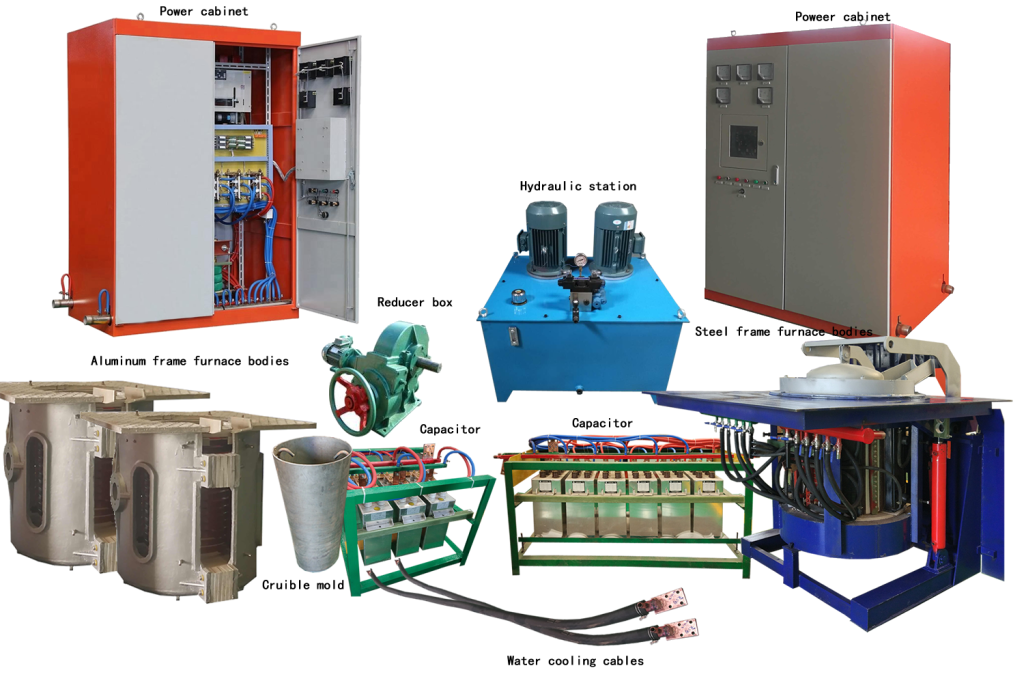
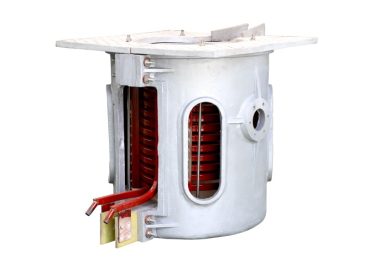
An MF induction melting furnace is an electrically powered melting system that uses electromagnetic induction to heat and melt metal from within.
It is widely used in steel mills and casting workshops due to its fast melting speed, strong adaptability, flexible operation, and effective electromagnetic stirring.
For industrial buyers, understanding the working principle directly affects:
Choosing the right configuration can reduce long-term operating costs significantly.
The furnace operates based on Faraday’s Law of Electromagnetic Induction.
When alternating current flows through an induction coil:
Unlike external combustion heating, the metal heats internally—resulting in higher efficiency and uniform temperature distribution.
This frequency adjustment is the key to improving heating efficiency.
The medium-frequency current flows through the copper induction coil, creating a strong alternating magnetic field around the crucible.
The metal charge acts as a secondary conductor. Eddy currents are generated inside the material itself.
Due to the metal’s electrical resistance, induced currents generate heat rapidly.
Heating occurs from the inside out, ensuring:
As the metal melts, electromagnetic forces create a natural stirring effect, resulting in:
Typical melting time: 40–60 minutes per heat, depending on capacity and material.
IGBT systems provide higher efficiency and better frequency control, while SCR systems are mature and cost-effective.
The modular electrical cabinet follows automotive wiring standards, ensuring easy maintenance and minimal wear parts.
Carbon-free hoses are used for water lines, and all manifolds and clamps are made of 304 stainless steel, improving durability.
Two main structural options:
This design ensures:
The equipment includes real-time detection of:
Stable cooling directly impacts system lifespan.
Modern MF furnaces include:
The self-test function continuously monitors system status, ensuring safe 24-hour operation.
Higher electrical efficiency reduces melting cycle time to 40–60 minutes.
Precise frequency regulation ensures stable output power and accurate temperature management.
15–30% lower energy consumption compared to fuel-fired systems.
Smaller footprint and flexible plant layout design.
Can integrate with:
Designed for 24-hour continuous operation, reducing labor and operational costs.
Capacity range: 0.1T to 20T, customizable according to production needs.
Proper configuration ensures optimal ROI.
Typically 40–60 minutes, depending on furnace power and material composition.
Varies by material, but significantly lower than traditional fuel furnaces.
Depends on material and operation, but stable temperature control extends lining life.
Yes. Designed for 24-hour operation with intelligent protection systems.
MF furnaces are evolving toward fully digital, data-driven melting solutions.
The MF Induction Melting Furnace works by converting electrical energy into controlled electromagnetic heat directly inside the metal.
This results in:
For modern steel plants, foundries, and recycling facilities, the MF induction melting furnace is not just a piece of equipment—it is a strategic investment in efficiency, stability, and sustainable growth.
Transformers are essential equipment in modern power transmission and distribution systems. In AC circuits, transformers are used to step up…
A Strategic Solution for Sustainable Industrial Heating I. The Growing Demand for Sustainable Industrial Heating 1.1 Global Pressure for Decarbonization…
I. Why Routine Maintenance Matters Medium-frequency furnaces are core heating and melting equipment in industries such as metallurgy and machinery…
Let’s be real — if you’ve ever worked in aluminum foundry operations, you know how temperamental melting can be.Sometimes your…