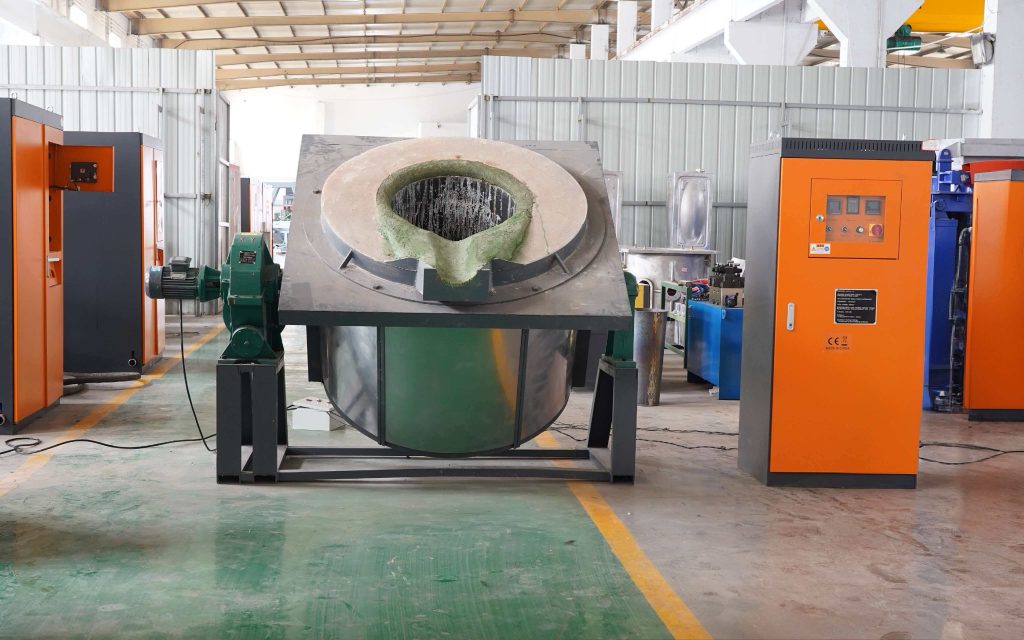
In an electrolytic aluminum plant, smelting furnaces and holding furnaces can be coordinated in the following ways:
The smelting process takes place in the smelting furnace, and the molten metal is transferred to the holding furnace, where it is held at a constant temperature; In this scenario, primary refining can be performed in the melting furnace, while secondary refining can be carried out in the holding furnace.
Both the melting process and holding are conducted in the same furnace, eliminating the need for transferring the molten metal; in this scenario, primary refining can be performed in the furnace, while secondary refining should be conducted outside the furnace using an in-line refining system. Currently, the results of off-line refining are better than those of in-furnace refining. In this case, adding an off-line refining unit can eliminate the need for an additional furnace, which is beneficial for ensuring product quality.
In this scenario, the first refining can be performed in the holding furnace, while the off-furnace in-line refining equipment serves as the second refining unit. This approach is beneficial for ensuring product quality and simultaneously improves the utilization rate of the furnace bank.
In this scenario, adding one furnace—so that one set of off-line refining equipment serves two furnaces—allows the first refining to be performed in the furnace and the second off-line. This not only improves the utilization rate of the furnace group but also eliminates the need for transferring the melt between furnaces, thereby helping to ensure melt quality.
Each of the above furnace group configurations is paired with a single casting machine.
In modern aluminum melting furnace systems, furnace coordination is not only a layout problem but also a key factor affecting production efficiency, metal quality, and energy consumption. The selection of a furnace configuration should be based on production scale, alloy requirements, and refining accuracy.
Molten aluminum is highly sensitive to temperature fluctuations. In industrial production environments:
Exceeding this range may lead to:
Therefore, modern holding furnaces must be equipped with:
Different aluminum melting furnace configurations show significant differences in energy consumption:
However, integrated systems require:
Aluminum melt quality depends heavily on hydrogen content and non-metallic inclusions.
Typical industrial targets:
Common refining technologies include:
Off-line refining systems generally provide more stable performance than in-furnace refining, especially in high-purity aluminum production.
A well-designed aluminum melting furnace system improves operational stability and production flexibility.
Typical industrial configuration:
Key design principles include:
Since all configurations are paired with a single casting machine, system synchronization is critical.
Key factors include:
Poor coordination may lead to:
The coordination of smelting furnaces and holding furnaces in electrolytic aluminum plants plays a critical role in determining product quality, energy efficiency, and production stability.
A modern aluminum melting furnace system should integrate:
Through optimized furnace group configuration, manufacturers can achieve:
As a professional manufacturer of aluminum melting furnace systems, we provide complete solutions covering furnace design, smelting and holding coordination, refining systems, and casting integration.
For project consultation, technical drawings, or system configuration advice, please contact our engineering team for professional support.
An Introduction to Medium-Frequency Induction Furnaces Induction furnaces that operate at frequencies ranging from 150 to 10,000 hertz are referred…
Introduction Selecting the right furnace capacity is not just a sizing exercise—it directly affects production efficiency, metal quality, energy consumption,…
Intermediate frequency (IF) furnaces are vital for efficient metal melting in industries like metallurgy and foundry. Low power output can…
1. Introduction In today’s highly competitive metal processing industry, the stainless steel melting furnace stands at the core of efficient…